

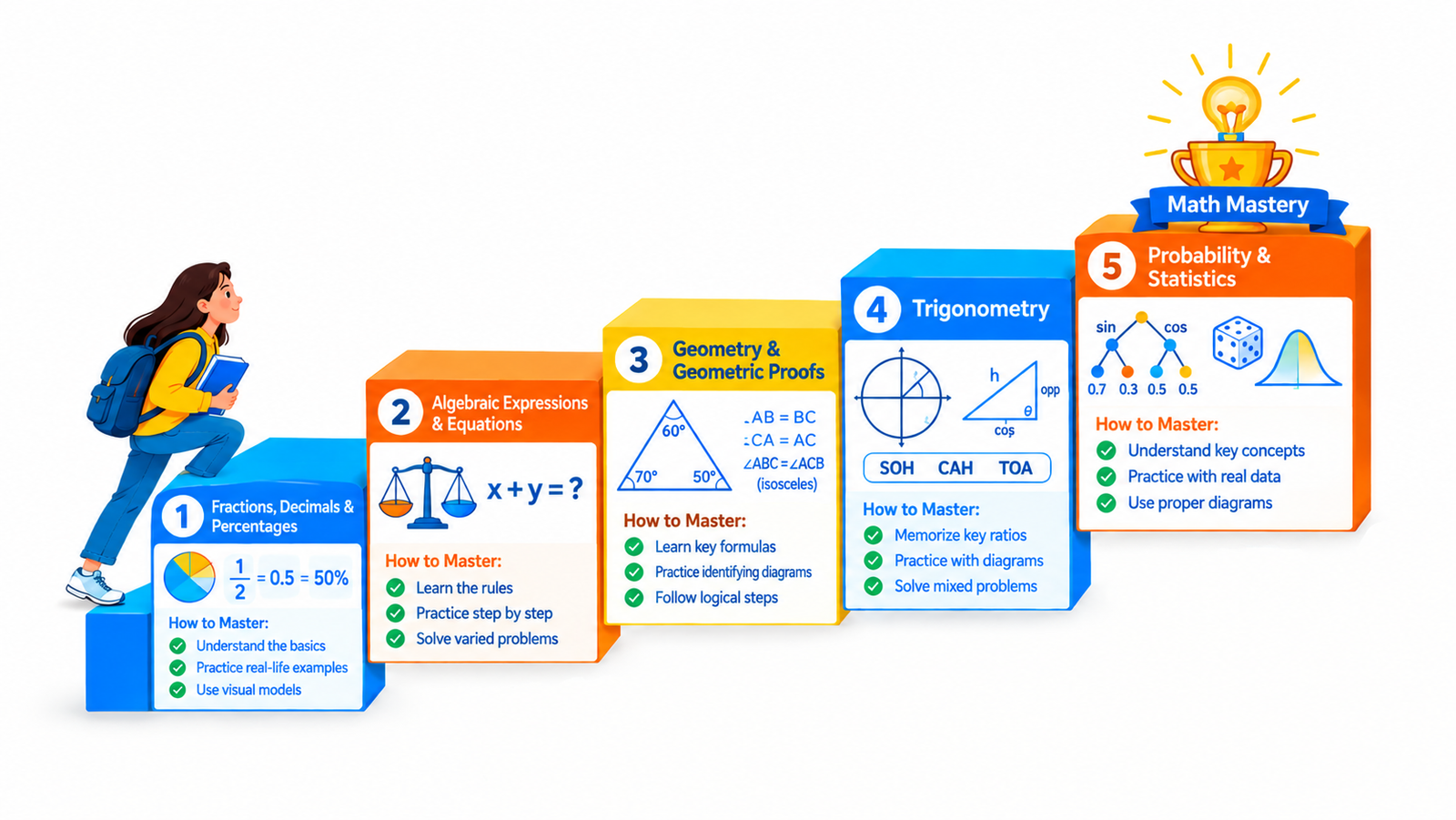
Top 5 Maths Concepts Students Struggle With (And How to Master Them)
Mathematics is a subject that builds step by step. When one concept feels unclear, the next one can feel even trickier. But here’s the good news: every maths concept can be learned with the right approach, patience, and practice. In this guide, we’ll look at the top 5 maths concepts students often find challenging — and share simple, practical ways to master each one.
Why Do Some Maths Concepts Feel Harder Than Others?
Before we dive in, it helps to understand why certain topics feel difficult. Most challenging maths concepts share a few common features:
- They require abstract thinking — you can’t always see or touch what you’re working with.
- They involve multiple steps — one small mistake early on can throw off the whole answer.
- They depend on earlier knowledge — if the foundation isn’t solid, the new concept feels shaky.
Understanding this helps us approach these topics with the right mindset. Let’s look at the five concepts students commonly find tricky.
1. Fractions, Decimals, and Percentages
Why it feels hard: Fractions, decimals, and percentages are different ways of expressing the same idea. Students often learn the rules for each separately but struggle to connect them. Research shows that decimal placement and fraction operations are among the most common areas where students make errors.
How to master it:
- Use real-life examples. Cooking, shopping, and sharing snacks are perfect ways to practice fractions. If a recipe needs 1/3 cup of flour, let your child measure it out.
- Draw pictures. Visual representations like pie charts or number lines help make fractions feel concrete instead of abstract.
- Connect the three forms. Show that 1/2, 0.5, and 50% all mean the same thing. Once students see the connection, the rules start to make sense.
- Practice with number lines. Number lines help students understand fractions as numbers with actual magnitude, not just symbols.
2. Algebraic Expressions and Equations
Why it feels hard: Algebra introduces letters into maths. Suddenly, students are working with unknowns instead of just numbers. The shift from arithmetic to algebra is a major turning point, and it’s where many students first feel truly challenged. Algebraic fractions, in particular, have been identified as one of the most difficult topics in algebra courses.
How to master it:
- Start with the “balance” idea. Think of an equation like a balance scale — whatever you do to one side, you must do to the other.
- Use concrete objects first. Algebra manipulatives (physical blocks or tiles) help students see what the symbols represent before working with abstract equations.
- Review factoring regularly. Mastering the greatest common factor, difference of squares, and trinomial factoring makes solving equations much smoother.
- Practice translating word problems. Many students find it hard to turn a sentence into an equation. Practice by reading a problem carefully, asking questions, and writing down what you know.
3. Geometry and Geometric Proofs
Why it feels hard: Geometry asks students to think visually and logically at the same time. Proofs, in particular, require building a step-by-step argument — not just calculating an answer. This type of abstract reasoning is very different from the number-crunching students are used to.
How to master it:
- Draw everything. Every geometry problem should start with a clear, labeled diagram. This makes relationships between angles, sides, and shapes much easier to see.
- Learn the key theorems. Understanding why theorems work — not just memorizing them — makes proofs feel less mysterious.
- Practice proofs from scratch. Don’t just read worked examples. Try writing your own proofs step by step, focusing on clear logical reasoning.
- Connect geometry to real life. Vectors, for example, are simply instructions for movement. You can explain them using directions around your home.
4. Trigonometry
Why it feels hard: Trigonometry combines algebra, geometry, and memorization. Students often learn SOH CAH TOA but then freeze when they need to decide which ratio to use. It also requires strong spatial awareness and formula recall under pressure.
How to master it:
- Understand the unit circle. The unit circle is the key to understanding sine, cosine, and tangent relationships. Use graphing technology to visualize how these functions behave.
- Draw triangles for every problem. Label the sides clearly before choosing a trigonometric ratio. This simple habit prevents many mistakes.
- Memorize key values. The sine and cosine values for common angles come up again and again. Learning how to derive them means you’ll never be stuck if you forget.
- Check your calculator mode. Always make sure your calculator is in the correct mode (degrees or radians) before solving.
5. Probability and Statistics
Why it feels hard: Probability problems often involve multiple steps and careful logical thinking. Conditional probability — where one event affects the likelihood of another — is especially tricky because it requires students to track how information changes the problem.
How to master it:
- Use tree diagrams and Venn diagrams. These visual tools make complex probability problems much easier to organize and solve.
- Start with simple counting. Understanding permutations and combinations builds the foundation for more advanced probability work.
- Practice with real examples. Card games, dice, and everyday situations like weather forecasts make probability feel relevant and easier to grasp.
- Break multi-step problems into smaller parts. Solve one piece at a time before combining the results.
General Tips for Mastering Any Maths Concept
No matter which concept you’re working on, these habits help:
- Practice regularly, not just before exams. Short, frequent study sessions are more effective than long cramming sessions.
- Focus on understanding, not memorizing. When you understand why a rule works, you can apply it flexibly to new problems.
- Revisit old material. A weekly review of past topics keeps earlier knowledge fresh and makes new topics easier to learn.
- Ask for help early. If something doesn’t make sense, ask a teacher, tutor, or study buddy before the confusion grows.
Frequently Asked Questions
Q: Which maths concept is the hardest for most students?
A: Algebraic fractions are consistently identified as one of the most difficult topics. Fractions, trigonometry, and geometric proofs also appear frequently on lists of challenging concepts.
Q: How long does it take to master a difficult maths concept?
A: It varies from person to person. Consistent practice over several weeks is usually more effective than trying to master everything in one session.
Q: Can maths concepts be mastered without a tutor?
A: Yes. With good resources, regular practice, and a willingness to ask questions, many students master challenging concepts independently. A study partner or online community can also help.
Q: What is the best way to practice maths?
A: Active practice — solving problems yourself, checking your work, and understanding your mistakes — is far more effective than just reading through notes or watching videos

Gurpal Singh
Gurpal Singh, founder - Lumens Academy.
B.E.( Mechanical Engineering )
Teaching experience : 15 years
Subjects : Maths