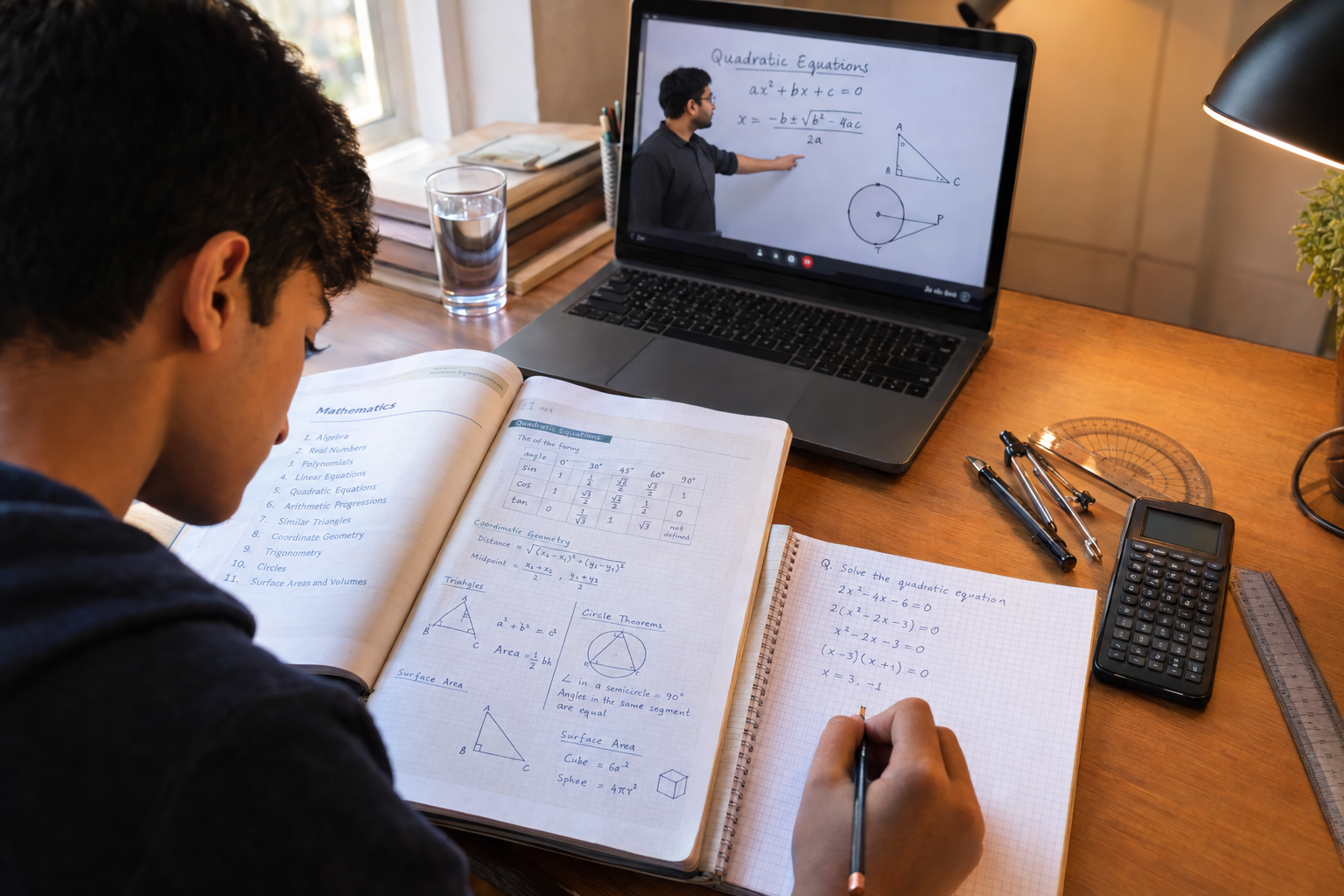


Class 10 Maths Board Exam: Last 30 Days Preparation Strategy
The last 30 days before the Class 10 Maths board exam are very important. You cannot learn everything from the beginning in these days. But you can revise the full syllabus, practice enough questions, and improve your confidence. With a good plan, you can score very well in Maths. This article from Lumens Academy gives you a simple 30-day preparation strategy.
Why the Last 30 Days Matter
Many students study for the whole year but lose marks in the last month because they do not plan well. The last 30 days are not only for studying. They are also for revision, practice, time management, and fixing mistakes. If you use these days properly, you can improve your score a lot.
Understand the Exam Pattern
The Class 10 Maths board paper is usually of 80 marks. The paper has different types of questions. Some questions are very short, some are short, and some are long. You need to practice all types. You should also learn how to write answers in a clean and step-by-step way. This helps you get more marks.
Know the Chapter Weightage
Before you start revision, you should know which chapters are more important. Number Systems carries about 6 marks. Algebra carries about 20 marks. Coordinate Geometry carries about 6 marks. Geometry carries about 15 marks. Trigonometry carries about 12 marks. Mensuration carries about 10 marks. Statistics and Probability carry about 11 marks. Algebra, Geometry, and Trigonometry are very important because they cover a large part of the paper. But do not ignore the smaller chapters. They are easy to score.
Phase 1: Days 1 to 7 – Build Your Basics
In the first week, focus on high-weightage chapters. On Day 1, revise Real Numbers and solve NCERT exercises. On Day 2, revise Polynomials and practice NCERT and Exemplar questions. On Day 3, revise Pair of Linear Equations and practice both graphical and algebraic methods. On Day 4, revise Quadratic Equations and practice factorisation, formula, and word problems. On Day 5, revise Arithmetic Progressions and practice nth term, sum, and application questions. On Day 6, revise Triangles and practice similarity theorems and proofs. On Day 7, revise Circles and practice tangent properties and proofs.
In this phase, study Maths for 4 to 5 hours every day. Do not only read the chapter. Solve every example and exercise. Board papers often follow NCERT patterns.
Phase 2: Days 8 to 14 – Complete the Syllabus and Take a Mock Test
In the second week, complete the remaining chapters. On Day 8, revise Coordinate Geometry and practice distance formula, section formula, and area of a triangle. On Day 9, revise Introduction to Trigonometry and practice ratios and identities. On Day 10, revise Some Applications of Trigonometry and practice heights and distances. On Day 11, revise Areas Related to Circles and practice sector, segment, and perimeter questions. On Day 12, revise Surface Areas and Volumes and practice questions on combinations of solids. On Day 13, revise Statistics and practice mean, median, and mode. On Day 14, revise Probability and practice simple probability questions.
On Day 14, take one full mock test. Sit for 3 hours without any disturbance. Use the same pen and stationery you will use in the exam. After the test, check your answers honestly. Write down every mistake in a notebook. This notebook will become your Error Log.
Phase 3: Days 15 to 21 – Practice Mock Tests and Fix Weak Areas
In this week, take one full mock test every two days. Practice in exam-like conditions. Keep an eye on time. On the other days, revise only the chapters where you lost marks. Make a Formula Notebook. Write all formulas, theorems, and identities in it. Revise this notebook for 15 minutes every morning.
Also work on your presentation. Write the formula first. Then substitute the values. Draw clean diagrams and label them. Write answers step by step. Even if your final answer is wrong, you can still get step marks.
Phase 4: Days 22 to 28 – Solve Previous Year Papers
In this week, solve at least five previous year board papers. Practice time management. Do not spend more than 2 minutes on a 1-mark or 2-mark question. Try to finish 5-mark questions in about 8 minutes. Look for repeated question types. In Trigonometry, identity proof questions come often. In Geometry, similarity and tangent proofs come often. Master these common question types.
Phase 5: Days 29 and 30 – Final Revision and Rest
In the last two days, do not start any new chapter. Revise your Formula Notebook, Error Log, and important theorems. Solve one last sample paper only for time practice. Do not try to learn new concepts. Pack your exam materials like admit card, pens, pencils, geometry box, and a transparent water bottle. Sleep by 10 PM. Good sleep helps your brain work better in the exam.
Daily Study Routine
Follow a simple daily routine. In the morning, study for 2 hours. Revise a chapter and solve NCERT problems. In the afternoon, study for 2 hours. Practice questions and previous year problems. In the evening, study for 1 to 2 hours. Revise formulas and work on weak areas. You can change the time according to your schedule, but keep the three-block structure. Consistency is more important than long study hours.
How to Use NCERT Books
NCERT books are the most important books for Class 10 Maths. Many board questions come directly from NCERT or are based on NCERT patterns. Read every chapter carefully. Solve all examples and exercises. Do not skip any exercise. If you understand NCERT well, you can score good marks.
How to Make a Formula Notebook
A Formula Notebook is a small notebook where you write all important formulas. Write formulas chapter by chapter. Add theorems and identities also. Revise this notebook every day for 15 minutes. This will help you remember formulas during the exam.
How to Maintain an Error Log
An Error Log is a notebook where you write your mistakes. After every mock test, write down the questions you got wrong. Also write why you got them wrong. Maybe you made a calculation mistake, or you forgot a formula, or you did not understand the question. Revise this log before the exam. It will help you avoid the same mistakes again.
Exam Day Strategy
Use the 15-minute reading time wisely. Read the whole paper and mark questions as easy, medium, and difficult. Start with easy questions. This builds confidence and secures marks. Always write the formula first. If you cannot complete the solution, the formula may still get you a mark. Draw diagrams with a pencil and label them. Do not overwrite. If you make a mistake, strike it out neatly and write the correct step beside it. Box your final answer and write units where needed. Attempt every question because there is no negative marking.
Common Mistakes to Avoid
Do not study only from guides. Do not ignore NCERT. Do not skip diagrams in Geometry. Do not write answers without steps. Do not spend too much time on one question. Do not stay awake late at night before the exam. Do not panic if you see a difficult question. Stay calm and try to solve it step by step.
How many hours should I study Maths daily in the last 30 days?
You should study Maths for 4 to 5 hours daily.
Include concept revision, practice, and mock tests in this time.
Is NCERT enough for Class 10 Maths board exam?
Yes, NCERT is the most important book for the exam.
Most board questions are based on NCERT patterns and examples.
How many mock tests should I take in the last 30 days?
You should take at least 8 to 10 full mock tests.
Take one mock test every two to three days and review your mistakes.
What should I do if I am weak in Maths?
Focus on NCERT first and solve all examples and exercises.
Take help from teachers or join Lumens Academy for doubt sessions.
How do I manage time during the exam?
Use the 15-minute reading time to scan the paper.
Start with easy questions and do not spend too long on one question.

Gurpal Singh
Gurpal Singh, founder - Lumens Academy.
B.E.( Mechanical Engineering )
Teaching experience : 15 years
Subjects : Maths
Related Posts