

Trigonometric Ratios Made Easy: Clear Sin, Cos, and Tan Basics
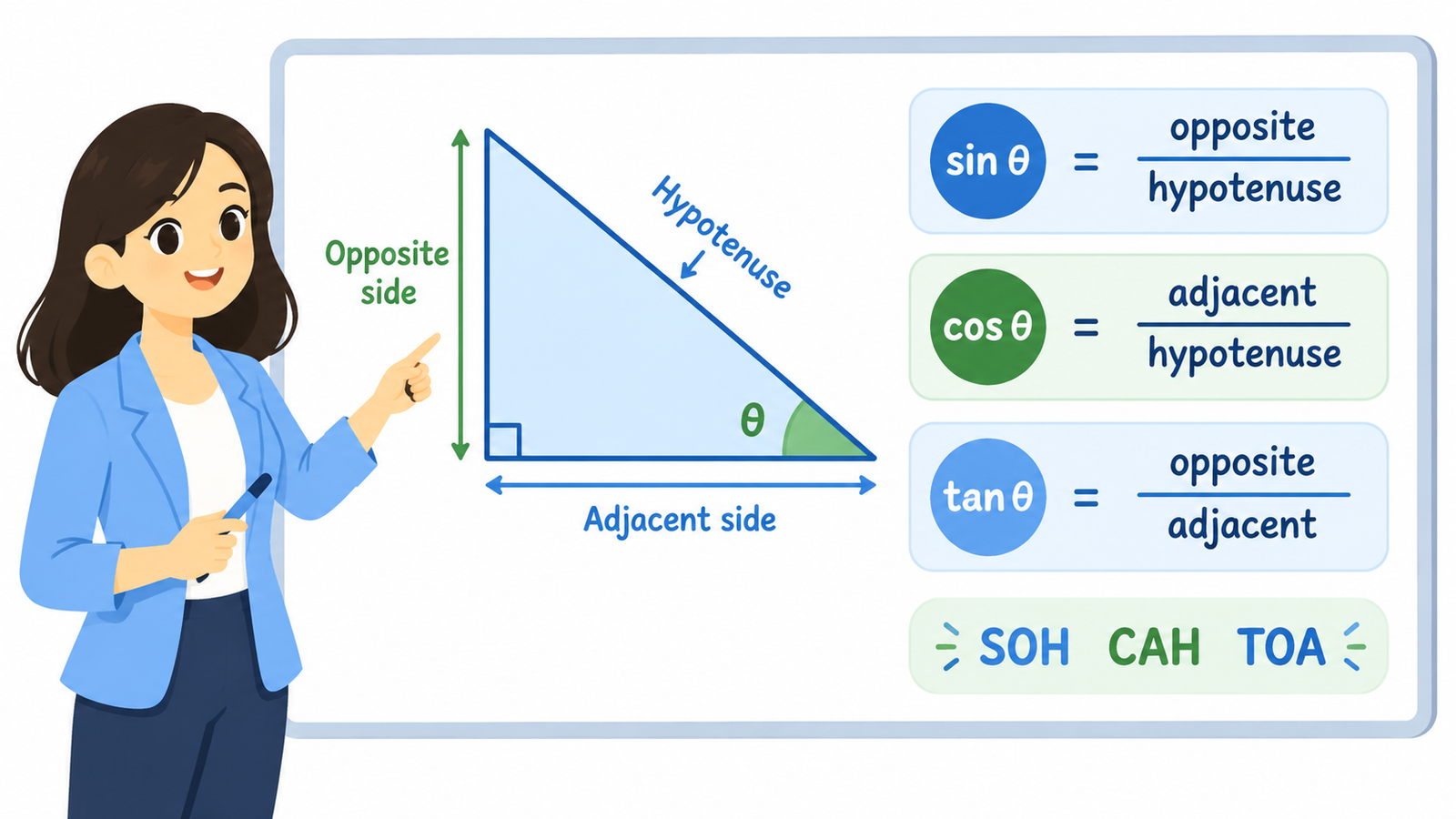
Trigonometry studies the relationship between the sides and angles of triangles. In a right triangle, three main ratios are used again and again. These are sine, cosine, and tangent. They are written as sin, cos, and tan. Each ratio compares two sides of a right triangle. The symbol θ is used for an angle. With these ratios, you can find a missing side or a missing angle. The formulas are simple and follow a clear pattern.
Trigonometry mainly works with right-angled triangles.
The three main ratios are sine, cosine, and tangent.
These ratios connect angles with side lengths.
Understanding the Right Triangle
A right triangle has one angle that is exactly 90 degrees. The longest side is called the hypotenuse. It is always opposite the 90-degree angle. For any other angle, the side across from it is called the opposite side. The side next to it is called the adjacent side. The words opposite and adjacent change when you choose a different angle. The hypotenuse stays the same.
For example:
sin θ = opposite side ÷ hypotenuse
cos θ = adjacent side ÷ hypotenuse
tan θ = opposite side ÷ adjacent side
These formulas show how the three sides are connected.
A right triangle has one 90-degree angle.
The hypotenuse is the longest side and is opposite the right angle.
Opposite and adjacent sides depend on the angle you are looking at.
The Sine Ratio and Its Formula
The sine ratio compares the opposite side with the hypotenuse. The formula is sin θ = opposite side ÷ hypotenuse. For example, sin 30° = 1 ÷ 2. This means that in any right triangle with a 30-degree angle, the opposite side is half the length of the hypotenuse. Sine is useful when you know the hypotenuse and need the opposite side. It is also useful when you know the opposite side and need the hypotenuse.
For example:
sin θ = opposite side ÷ hypotenuse
If opposite side = 3 and hypotenuse = 6, then sin θ = 3 ÷ 6 = 0.5
So θ = 30°.
Formula: sin θ = opposite side ÷ hypotenuse.
Sine helps find the opposite side or the hypotenuse.
The sine value for a fixed angle stays the same in every right triangle.
The Cosine Ratio and Its Formula
The cosine ratio compares the adjacent side with the hypotenuse. The formula is cos θ = adjacent side ÷ hypotenuse. For example, cos 60° = 1 ÷ 2. This means that in any right triangle with a 60-degree angle, the adjacent side is half the length of the hypotenuse. Cosine is useful when you know the hypotenuse and need the adjacent side. It is also useful when you know the adjacent side and need the hypotenuse.
For example:
cos θ = adjacent side ÷ hypotenuse
If adjacent side = 4 and hypotenuse = 8, then cos θ = 4 ÷ 8 = 0.5
So θ = 60°.
Formula: cos θ = adjacent side ÷ hypotenuse.
Cosine helps find the adjacent side or the hypotenuse.
The cosine value for a fixed angle is always the same.
The Tangent Ratio and Its Formula
The tangent ratio compares the opposite side with the adjacent side. The formula is tan θ = opposite side ÷ adjacent side. For example, tan 45° = 1. This means that when the angle is 45 degrees, the opposite side and adjacent side are equal in length. Tangent uses only the opposite and adjacent sides. It is helpful when you know both of these sides. It is also helpful when you know one side and the angle and need the other side.
For example:
tan θ = opposite side ÷ adjacent side
If opposite side = 5 and adjacent side = 5, then tan θ = 5 ÷ 5 = 1
So θ = 45°.
Formula: tan θ = opposite side ÷ adjacent side.
Tangent uses the opposite side and the adjacent side.
Tangent is useful for finding an angle or a missing side.
Remembering the Ratios with SOH CAH TOA
SOH CAH TOA is a simple memory aid for the three ratios. SOH means sine equals opposite over hypotenuse. CAH means cosine equals adjacent over hypotenuse. TOA means tangent equals opposite over adjacent. Writing SOH CAH TOA at the top of your notes can help you choose the right formula. It keeps the three ratios clear in your mind.
For example:
SOH: sin θ = opposite side ÷ hypotenuse
CAH: cos θ = adjacent side ÷ hypotenuse
TOA: tan θ = opposite side ÷ adjacent side
These three formulas cover the main trigonometric ratios.
SOH means sin θ = opposite ÷ hypotenuse.
CAH means cos θ = adjacent ÷ hypotenuse.
TOA means tan θ = opposite ÷ adjacent.
Finding a Missing Side with Sin, Cos, and Tan
To find a missing side, you need one angle and one side. First, label the sides as opposite, adjacent, and hypotenuse. Then choose the formula that connects the known side with the unknown side. Substitute the known values into the formula. Solve the equation to find the missing length. This step-by-step method works for many right triangle problems.
For example:
sin θ = opposite side ÷ hypotenuse
cos θ = adjacent side ÷ hypotenuse
tan θ = opposite side ÷ adjacent side
If hypotenuse = 10 and θ = 30°, then sin 30° = opposite ÷ 10. Since sin 30° = 0.5, opposite = 5.
If hypotenuse = 10 and θ = 60°, then cos 60° = adjacent ÷ 10. Since cos 60° = 0.5, adjacent = 5.
If opposite = 6 and adjacent = 8, then tan θ = 6 ÷ 8 = 0.75.
Identify the known angle and the known side.
Choose the formula that links the known side to the unknown side.
Substitute the values and solve for the missing side.
Finding a Missing Angle with Inverse Trigonometric Ratios
When you know two sides, you can find a missing angle. Use the inverse form of the ratio. The inverse sine is written as sin⁻¹. The inverse cosine is written as cos⁻¹. The inverse tangent is written as tan⁻¹. These inverse functions help you move from a ratio back to an angle. This skill is useful when measuring an angle directly is not possible.
For example:
θ = sin⁻¹(opposite side ÷ hypotenuse)
θ = cos⁻¹(adjacent side ÷ hypotenuse)
θ = tan⁻¹(opposite side ÷ adjacent side)
If opposite = 3 and hypotenuse = 6, then sin θ = 3 ÷ 6 = 0.5, so θ = sin⁻¹(0.5) = 30°.
If adjacent = 4 and hypotenuse = 8, then cos θ = 4 ÷ 8 = 0.5, so θ = cos⁻¹(0.5) = 60°.
If opposite = 5 and adjacent = 5, then tan θ = 5 ÷ 5 = 1, so θ = tan⁻¹(1) = 45°.
Use sin⁻¹ when you know the opposite side and hypotenuse.
Use cos⁻¹ when you know the adjacent side and hypotenuse.
Use tan⁻¹ when you know the opposite side and adjacent side.
Real-World Uses of Trigonometric Ratios
Trigonometric ratios are used in many real situations. Engineers use sin, cos, and tan to study forces and design structures. Architects use them to plan roofs, ramps, and angled parts of buildings. Surveyors use them to measure the height of a tree, building, or hill. Navigators use them to find distances and directions. These ratios help turn angle measurements into useful side lengths.
For example:
sin θ = opposite side ÷ hypotenuse
cos θ = adjacent side ÷ hypotenuse
tan θ = opposite side ÷ adjacent side
The height of a tree can be found using tan θ = opposite ÷ adjacent.
A ramp angle can be checked using sin θ = opposite ÷ hypotenuse.
A distance across a river can be estimated using cos θ = adjacent ÷ hypotenuse.
Engineers use trigonometric ratios to study structures and forces.
Architects use them to design roofs, ramps, and angled features.
Surveyors and navigators use them to measure heights and distances.
Building Confidence with Practice
Regular practice makes trigonometric ratios easier to use. Start with simple right triangles. Label the opposite, adjacent, and hypotenuse sides for different angles. Write the formula before solving each problem. Use SOH CAH TOA to remember the three ratios. Apply sin, cos, and tan to simple real-life examples. With time, choosing the right formula can feel more natural.
For example:
sin θ = opposite side ÷ hypotenuse
cos θ = adjacent side ÷ hypotenuse
tan θ = opposite side ÷ adjacent side
Write these three formulas before solving each problem.
Practice labelling opposite, adjacent, and hypotenuse for different angles.
Write the formula before solving each problem.
Apply sin, cos, and tan to simple real-world examples.
Final Thoughts
Sine, cosine, and tangent are simple tools for working with right triangles. The formulas connect angles with side lengths. They help find missing sides and missing angles. With clear basics and regular practice, trigonometric ratios become easy to understand and use.
For example:
sin θ = opposite side ÷ hypotenuse
cos θ = adjacent side ÷ hypotenuse
tan θ = opposite side ÷ adjacent side
These three formulas are the foundation of trigonometric ratios.
Sin, cos, and tan compare different pairs of sides.
The formulas work for every right triangle.
Regular practice helps build strong trigonometry basics.
What are sin, cos, and tan?
Sin, cos, and tan are trigonometric ratios for right triangles. They compare two sides of the triangle with each other.
What is the formula for sine?
The formula for sine is sin θ = opposite side ÷ hypotenuse. It helps find the opposite side or the hypotenuse when one angle is known.
What is the formula for cosine?
The formula for cosine is cos θ = adjacent side ÷ hypotenuse. It helps find the adjacent side or the hypotenuse when one angle is known.
What is the formula for tangent?
The formula for tangent is tan θ = opposite side ÷ adjacent side. It helps find a missing side or angle when opposite and adjacent sides are involved.
What is SOH CAH TOA?
SOH CAH TOA is a memory aid for the three ratios. SOH means sin = opposite ÷ hypotenuse, CAH means cos = adjacent ÷ hypotenuse, and TOA means tan = opposite ÷ adjacent.
Why are sin, cos, and tan useful in real life?
They help measure heights, distances, angles, and forces. Engineers, architects, surveyors, and navigators use them in many practical tasks.

Gurpal Singh
Gurpal Singh, founder - Lumens Academy.
B.E.( Mechanical Engineering )
Teaching experience : 15 years
Subjects : Maths