
Surface Area and Volume Class 9 Formulas: A Complete Guide
Understanding the space occupied by an object and the material needed to cover it is a fundamental part of geometry. In Class 9 Mathematics, the chapter on Surface Areas and Volumes introduces key concepts that help us measure real-world objects like boxes, water tanks, and ice cream cones. This guide covers the essential formulas for calculating the surface area and volume of various 3D shapes.
Understanding Surface Area
Surface area is the total area that the surface of a three-dimensional object occupies. It is essentially the amount of material required to cover the shape. There are two types of surface areas you will study: Total Surface Area (TSA), which includes all faces of the object, and Curved or Lateral Surface Area (CSA or LSA), which includes only the curved parts of the shape.
Total Surface Area (TSA): The sum of the areas of all faces, including the top and bottom.
Curved Surface Area (CSA): The area of only the curved surface, excluding the flat bases.
Understanding Volume
Volume is the measure of the amount of space enclosed within a three-dimensional object. While surface area is measured in square units (like cm² or m²), volume is measured in cubic units (like cm³ or m³). It tells you how much the object can hold, such as the amount of water a bottle can contain.
Volume: The total capacity or space occupied inside the 3D shape.
Unit: Volume is always expressed in cubic units (e.g., cubic centimeters, cubic meters).
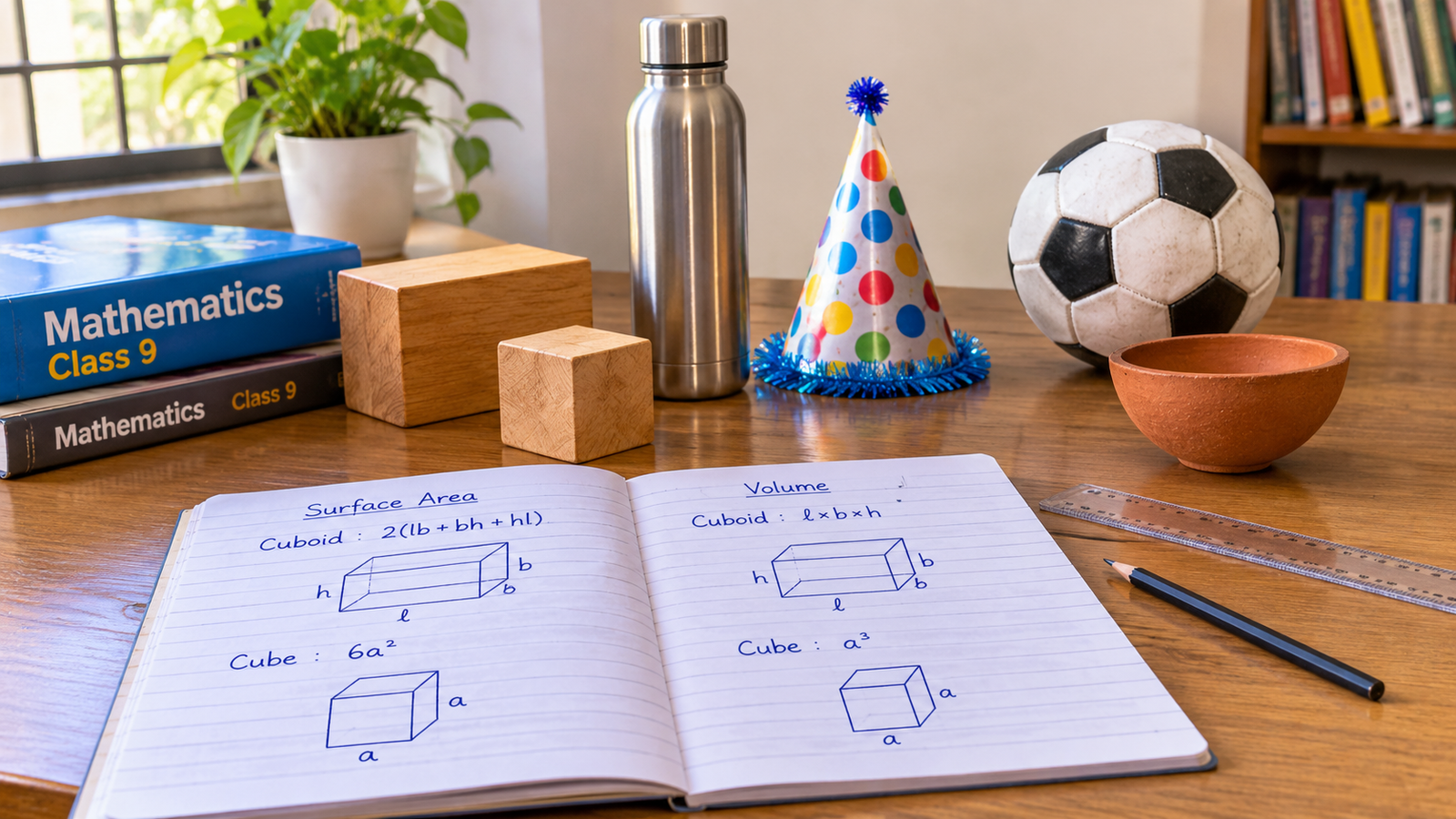
Formulas for a Cuboid
A cuboid is a box-like shape with six rectangular faces, where opposite faces are equal. Common examples include bricks, books, and matchboxes. Let the length be ‘l’, breadth be ‘b’, and height be ‘h’.
Total Surface Area: 2(lb+bh+hl)2(lb+bh+hl)
Lateral Surface Area: 2h(l+b)2h(l+b)
Volume: l×b×hl×b×h
Note: The lateral surface area is useful when you need to paint the walls of a room but not the ceiling or floor.
The formula for TSA includes all six faces of the cuboid.
The volume formula multiplies the three dimensions: length, breadth, and height.
Formulas for a Cube
A cube is a special type of cuboid where all sides are equal. Think of a dice or a Rubik’s cube. If the side of the cube is ‘a’, the formulas become simpler. Since all dimensions are the same, the length, breadth, and height are all equal to ‘a’.
Total Surface Area: 6a26a2
Lateral Surface Area: 4a24a2
Volume: a3a
Note: The volume of a cube is often referred to as the side cubed.
A cube has 6 equal square faces, which is why TSA is 6a26a2.
The volume is the side length multiplied by itself three times.
Formulas for a Right Circular Cylinder
A cylinder is a solid shape with two parallel circular bases connected by a curved surface. Examples include pipes, cans, and water tanks. Let ‘r’ be the radius of the base and ‘h’ be the height of the cylinder.
Curved Surface Area: 2πrh2πrh
Total Surface Area: 2πr(r+h)2πr(r+h)
Volume: πr2hπr2h
Note: The curved surface area is the area of the rectangular sheet that wraps around the cylinder.
The volume formula is the area of the circular base (πr2πr2) multiplied by the height.
TSA includes the curved area plus the area of the top and bottom circles.
Formulas for a Right Circular Cone
A cone is a shape with a circular base that tapers to a point called the vertex. Ice cream cones and party hats are common examples. Let ‘r’ be the radius, ‘h’ be the height, and ‘l’ be the slant height of the cone. The relationship between these is l2=r2+h2l2=r2+h2.
Curved Surface Area: πrlπrl
Total Surface Area: πr(r+l)πr(r+l)
Volume: 13πr2h
1πr
h
Note: The slant height ‘l’ is the distance from the top point to the edge of the circular base.
The volume of a cone is exactly one-third of the volume of a cylinder with the same radius and height.
The slant height is used to calculate the curved surface area.
Formulas for a Sphere
A sphere is a perfectly round 3D object, like a ball. Every point on the surface is equidistant from the center. Let ‘r’ be the radius of the sphere.
Surface Area: 4πr24πr2
Volume: 43πr334πr
Note: Unlike other shapes, a sphere does not have a separate curved and total surface area because it has only one continuous surface.
The surface area of a sphere is four times the area of its great circle (πr2πr2).
The volume formula involves the radius cubed.
Formulas for a Hemisphere
A hemisphere is exactly half of a sphere, like a bowl or half a watermelon. When calculating surface area for a hemisphere, it is important to distinguish between the curved surface and the total surface. Let ‘r’ be the radius.
Curved Surface Area: 2πr22πr2
Total Surface Area: 3πr23πr2
Volume: 23πr3
πr
Note: The total surface area of a hemisphere includes the curved surface area plus the area of the flat circular base (
πr2πr2).
The volume of a hemisphere is half the volume of a full sphere.
The total surface area is 3πr23πr2 because it adds the base area to the curved area.
What is surface area in Class 9 Maths?
Surface area is the total area covered by the outer surface of a 3D shape. It is measured in square units like cm² or m².
How manyWhat is volume in Class 9 Maths? important math formulas are covered in this article?
This article covers 17 important math formulas for students. They include basic algebra, geometry, trigonometry, caVolume is the amount of space enclosed inside a 3D object. It is measured in cubic units like cm³ or m³.lculus, and everyday math formulas.
What is the difference between total surface area and curved surface area?
Total surface area includes all faces, including flat bases. Curved surface area includes only the curved part of the shape.
What is the formula for the volume of a cylinder?
The volume of a cylinder is πr2hπr2h. Here, rr is the base radius, and hh is the height.
What is volume in Class 9 Maths?
Volume is the amount of space enclosed inside a 3D object. It is measured in cubic units like cm³ or m³

Gurpal Singh
Gurpal Singh, founder - Lumens Academy.
B.E.( Mechanical Engineering )
Teaching experience : 15 years
Subjects : Maths